Tuesday, September 21, 2010

Yunnan Pt. 3: Close to the Edge


On Day 3, we journeyed north towards Shangri-La. On the way we had decided to stop and see the famous Tiger Leaping Gorge before they decided to build a dam there and destroy the whole thing. Originally I had thought that we could hike the length of the Gorge, spending the night in a guesthouse along the path, but soon I realized that A. We had limited time and B. We were not good hikers. So the plan was to stop at the Gorge, take a mini-bus to a scenic point, and then get on our way again to "Poor Man's Tibet."

After weaving through the mountains north of Lijiang, our bus dropped us off in the miserable little town of Qiaotou. The only industry in the town, it seemed, was the "Tourist" (-scam) industry. At this point LP failed us completely: There weren't any buses, the sketchy people told us, because of road work. But we could take a gypsy cab for about 300 RMB. I thought it was a scam at first, but it was obvious that we had no other choice if we wanted to see the damn thing. We paid a driver and then roared off down a gravel road.

Immediately we had to stop and wait for fifteen minutes for them to finish doing something to the road--clearly there was construction, but still 300? But then we were off again passing several other gypsy cabs along the way. Good, at least we weren't the only ones foolish enough to do this.

But we were foolish, or foolhardy at least. It turned out that it cost 300 because it was so ridiculously dangerous. The "road" was in a horrible condition due to the construction, and was littered with construction equipment that our crazy driver had to navigate in our top-heavy vehicle. For most of the journey we had a sheer 100-meter drop to our right. Oh, and we passed several waterfalls to our left. Caution: You May Get Wet.


But despite the danger, it was well worth the trip. The Gorge was stunningly beautiful--much more spectacular than the Three Gorges Area (and cleaner). Opposite us was the massive face of Snow Mountain, the other side of which we had ascended the day before.

We stopped about halfway through at a little "toll" area. You paid some money to the people who controlled that portion of the trail and then you could walk down to the river. While our driver waited up top we climbed down, passing bored-looking Naxi youths selling sports drinks and colas to passers-by. It was a pretty trail that took us through bamboo and through blasted-out rock, but tricky and steep--safety is interpreted much more loosely in China, if you can't already tell.

At the bottom it leveled out and we followed the river up to some rapids. The trail passed into someone else's jurisdiction, so we had to pay more money to walk out onto a boulder in the middle of the river. But still, worth it:

But climbing out of it really sucked.
Leb Wohl.

Yunnan Pt. 2: Playing with Fire

The night after our ascent up Snow Mountain, we visited Shuhe, another "old village" north of Lijiang, for their annual torch festival in honor of some Dongba deity (Dongba being the traditional Naxi faith). Shuhe was a lot like Lijiang, but smaller and cozier.

In the town square there was a large circle of people dancing around a giant torch. Peddlers sold personal torches of bundled-wood that you could stick flowers into. Yu Yun bought one and personalized it with her own vegetation:


At first I thought we were supposed to wait for the fire to reach the bottom of the central torch, and then light our torches from it, Olympic-style. But each time I though it the thing was going to burst into a bonfire, I was sadly disappointed--the flames just very slowly burned downward like a candle. Regardless of whether we were supposed to wait or not, people began lighting their own and then sharing. It was difficult at first to catch Yun's on fire, but later we discovered we had been going about it all wrong:


After we spent about half and hour appreciating the fact that we were in a tight crowd of people (including many children) playing with fire, we decided to leave. Yun's torch took forever to burn out so we had to douse it in one of the little canals next to the street. I donated the leftover tinder to a group of poor pyromaniacs:

Leb Wohl.

Thursday, September 2, 2010

Yunnan Pt. I


Northwest Yunnan province, a high, mountainous region close to Tibet, would be my last trip this semester. The landscape around Lijiang, the area's biggest city and our first stop, turned out to be not much different than my beloved Appalachia, but it was still the cleanest, most beautiful place I had yet been in China. Yu Yun was amazed by how blue the sky was. Our hostel was nestled in the Lijiang Gu Cheng, or old town, which we explored that evening after we arrived. I had been to several old towns in China, one of which was featured in a well-known action movie.


But in Mission Impossible III Tom Cruise wasn't really running through the streets of Shanghai, but through the little water village of Xitang, and hour and a half away. This is because Shanghai doesn't look that Chinese anymore. Or anywhere in China for that matter. The "old towns" are architecturally authentic but have been so commercialized they are hardly "ancient" anymore. Xitang may have looked exotic on film but that's because most of the denizens (tourists and merchants taking tourists' money) where removed to make it look what like what Americans expect China to look like. Unfortunately this includes Old Town Lijiang as well, though on a much bigger scale. But despite how tourism and capitalism has fundamentally changed old China, new old China, and the Euro-backpackers that infest it, still has a lot of charm in a different sort of way, especially in remote Yunnan where industrial pollution doesn't obscure it. Epcot it ain't.

A very authentically Chinese sight

A outside Lijiang city the old life still holds sway. The fields and roads are sparsely populated, save for the Naxi villagers growing their corn and potatoes. I often saw Naxi women, in their eclectic modern-traditional dress, carrying huge baskets of crops on their backs to a fro. As part of their traditional matriarchal culture, Women were, and to some extent still are, the literal backbone of the Naxi workforce. Mini-buses carting tourists between the area villages often speed by, but it is nothing compared to the thousands of green, honking taxis clogging Changzhou's cement arteries.


Natural beauty also surrounds Lijiang. Though the immediate mountains were not so imposing, Yulong Xueshan (Jade Dragon Snow Mountain) looms, perpetually cloud-covered, in the distance.
Natural Beauty

Yu Yun and I rode horses part of the way up its slope on the second day. Our guides were of course Naxi women, the sames ones who told us how hard-working Naxi women are, from which I inferred how lazy their husbands must then be. (Apparently only in Southwestern China do they openly admit a truth that other world cultures deny). We did not get very far up the mountain. After two hours our guides started leading our horses up a tight, steep path and the animals started to slip on the loose rocks--we had not taken the way up Lonely Planet advised, but had seemed reasonable--but by then it was apparent that we were the only tourists going up that far along this particular route.


Apparently our guides were just waiting for us to tell them when to turn around. Or maybe they were curious just how reckless a dumb foreigner and naive Han Chinese would be in the wilderness. After all, they weren't the ones on horses. To be more specific, one geezer horse that only had one more season before retirement, and a stubborn junvenile that attempted to eat everything green in sight. Not the party you wanted to take up on the "adventurous" side of the mountain, unless perhaps you were the Donners. Eventually Yu Yun decided that we had gone beyond our insurable limit and so we told our guides to turn the horses around--but not before we had gone far up a dangerous path, making it all the more difficult to get back down.

Leb Wohl.

Tuesday, August 17, 2010

EXPOsed


The Expo is in Shanghai this year. For those of you who don't know what the Expo is, it's what many call the "World's Fair." If you don't know what that is, well, it's a big exhibition every two years or so where countries and companies show off or "exchange" their advances in culture and technology.


Shanghai got it this year, and won't shut up about it. Like the Olympics, EXPO 201o is a big deal for the Chinese. Unlike the Olympics, nobody else in the world cares about it. I was once asked if foreigners would come to visit Shanghai to visit it, to which I responded "no," unless of course they were expatriates who were living in the vicinity. Which I was, so I went. Twice.

What you do at Expo is simple-- You pay 150 Yuan to wait in line for an hour to enter the site, walk to a pavilion that you want to visit, then you wait in another line for over 2 hot, miserable hours to enter. The really popular ones, such as Germany or Japan, can take up to 4 or 5 hours to get into (we managed them in about 4). From what I heard Saudi Arabia was the longest wait at nearly 8, thought some had clocked 5 or 6. The Chinese Pavilion was open only to special reservations, as were Taiwan and Hong Kong (yes they had their own). Smaller ones like Oman, Israel and Argentina only took a matter of minutes to get into, but also risked sucking, like Slovenia. We had purchased little Expo-passports that you could get stamped at each place, so we attempted two long lines each day, and killed the remaining time at the smaller, quicker pavilions.

Queuing is a western concept which was only recently forced on the Chinese, and believe me they hate it. Despite the country's Buddhist legacy, people here are very impatient. Jumping queues is very common, therefore you have to fight to maintain your position in any line at the train station or dino-park. Line rules were well-enforced at Expo (for once), but people would still push past you for the slightest advantage and fill in any available space. As a social experiment my friends and I fought to maintain about 1.5 meters of difang (space) in front of us while people piled up behind.

Most of pavilions were interesting, though never worth the wait. While the event's theme was "better city, better life," most, like Spain's, were just expensive exhibits of their culture and history presented on massive video screens. Though Spain's did have a freaky, giant animatronic baby that greeted you at the end. I was disappointed (but unsurprised) that Germany's "Balancity" actually followed the prompt and presented a polished but less exciting array of environmentally-friendly and sustainable technology, ending with a giant orb which reacted to the audience's energy. Others, like Israel, emphasized (or pandered perhaps) their positive efforts with China to make the world a better place. The entire exhibit in Japan's Pokemon-shaped building was based around one of the ugliest white birds you have ever seen. Apparently this Ibis went extinct in Japan so they found more in China and imported them. As presented in crystal clear video by Canon. At the end a little Chinese boy then sang a song about it while masked people road around the stage on futuristic Honda scooter-cars. Yu Yun liked it.


But the best pavilion by far was North Korea. Upon entering you were greeted by the rainbows and fountains of a cheap, socialist dream world. It was the kind of thing so over-the-top and fake that you immediately felt like you were livestock in an abattoir being comforted before you reached the rotating knives. There was very little English, but above the TV monitors showing harmonious scenes of opera, soccer, and factory work, was the simple phrase: "paradise of people."


Next to North Korea was Iran, but my Chinese friends didn't want to go in. Apparently the Third World just didn't hold the same absurdist wonder for them.

Leb Wohl.

Saturday, July 24, 2010

No Bros


The train ride back from Xi'an was a delight. We had splurged on "soft sleeper" seats, which had only four beds (as opposed to six) which were bigger and more comfortable. Yu Yun had mistakenly put us different cabins and it turned out that she got the boring one (explained in a moment). She tried to switch with the odd, quiet woman in the bunk above mine, but she didn't want to move.

If she had had any foresight she certainly would have wanted to, because opposite us was a family with two young boys, sharing two bunks with mom and granddad. All evening they were climbing over the bunks, playing under the blankets, jumping from one side to the other, and at certain times escaping into hall with mother and grandpa in hot pursuit. The youngest (about 3) capriciously kept demanding to be moved from the top bunk to the lower one and even sometimes venturing over to mine, but that was only when he wasn't chasing after his brother or looking for ghosts out the window. His "Ge Ge" (older brother) enjoyed playing with him for intervals of about 10 minutes. Then he would get tired and start fighting with him over something, at which point mom would intercede and he would cry about how she loved "Di Di" more than him. It occurred to me that this interplay was something I hadn't seen much of in China, and there's a good reason why.


Because of the one child policy, parents are not supposed to have more than one son. In rural families, if the first child is a girl, then they may have a second child, and there are other exceptions, including a fine for "breaking" the rules. Yu Yun talked with the mother and found out that they were from Jiangsu province, but the oldest was attending school in Beijing (to ensure he learns proper Mandarin) which confirmed that the family was probably pretty well-off. So if they didn't already have connections with the powers that be, they could probably handle the fines. But most of the young people I know, including the students I teach, are only-children, or just have sisters (ewwww, sisters :)) so a big or little brother is an uncommon sight.

I couldn't help but wonder how this changers Chinese society. You might think I am being biased as a (lousy) older brother myself, but I think it's just as critical as any other relationship within the family. Each kind of sibling bond, whether sister-sister, brother-brother, or sister-brother, is important because they help shape our personalities. But what is a society that has few older brothers? Or few younger sisters? Or any siblings at all? I am not going to venture into psychology, but older brothers (at least good ones) provide a male role model for their siblings, just as older sisters serve as female role models. All are siblings are part of our coming-of-age process.

In the US those of us without one kind of sibling-bond can look elsewhere in our family or friends for the kind of reinforcement we need, but what if there aren't any older brothers or sisters at all? In China cousins are typically referred to as brothers or sisters, but cousins usually aren't always around, though extended family is usually close-knit. In most households grandparents take care of the child while the parents work, so a lot of time is spent with grandma or grandpa, but as entertaining as mahjong, knitting, or poker is, sometimes you just want to play with someone your own age, which is something not all Chinese youth have outside of school. Boredom and isolation is a common phenomenon among Chinese youth, especially those from one-child families, who turn to the internet and World of Warcraft for amusement, which lead to problems like this. A brother or sister is an invaluable playmate and confidant you can rely on when you are young.

Now excuse me as I prepare for my sister's rebuttal.
Leb Wohl.

Thursday, July 22, 2010

The Sewer at the Center of the World


The Yangzi is dirty, really dirty. That's what I noticed when I took a cruise on it with 3 of the other teachers. A boat trip through the Three Gorges area is a standard Chinese vacation. If you're like us and like to ride cheap, you get on a small, rusty ferry-like vessel and spend 3 nights sweating profusely in a four-person cabin with a Chinese toilet that produces wonderful smells. The river is completely brown and profuse with garbage. Paradise on earth.

That toilet started a ruckus the moment we saw it. You see, a western toilet had been a selling point for the entire trip, and once realized the lack thereof, the arguments started and our booking agent, "Jimmy" Yin bolted. It turned out we had gotten some bad information from certain parties and Jimmy wasn't really at fault, which I told him when I caught up to get the room key. However, Jimmy did manage to put us at the immediate fore section of the ship, so the 4 biggest people on the boat were occupying the smallest room.

It was nice to wake up that first morning, drenched with sweat because they turned the AC off at 11 and ponder the misery that we had shelled out 5oo Yuan for. That first day, walking up this silly historical-theme-park tourist-trap "ghost mountain" thing, I felt like a human faucet. Gradually I began to adapt to the discomfort. I stole some deck chairs from the "entertainment" deck and we passed the time reading on the foredeck, where there was a breeze...when the ship was moving. Aside from a Korean couple, and a Chinese-American family from San Francisco, we were the only foreigners on the voyage. The Chinese passengers busied themselves doing laundry, playing cards, drinking beer, and eventually stripping to their waist.


This explains a lot.

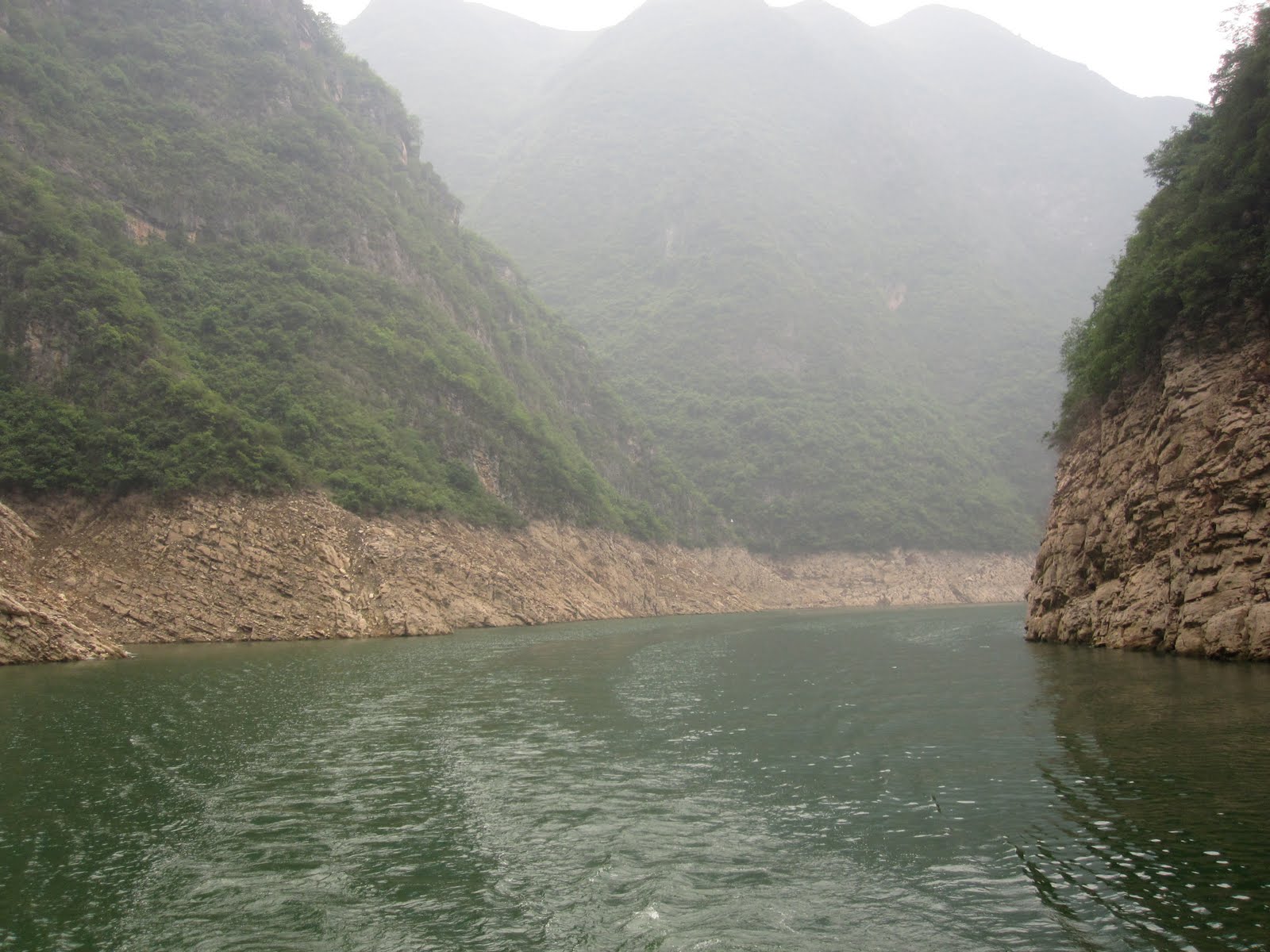
The cruise took us through some empty, dingy towns and some pretty "meh" tourist attractions. On the third day we reached the gorges. The first was quite astounding, but short, and the second two equally majestic, but more of the same. The real treats were the "Lesser" Gorges, which we reached by taking a smaller boat up another river. The water turned green and blue and the cliffs came closer as the river narrowed. When we stopped at the beginning of the 3rd "Lesser," Sean and I decided to blow 10 Yuan on "smart water" from a "wise spring" up on the cliff face. We later boarded a smaller skiff which took us further up the narrowest part of the gorge while the boatswain sang unintelligible river songs and the tourists took action shots wearing traditional fisherman's garb at the front of the boat.


We reached the dam--the massive monstrosity which supposedly made the Gorges less beautiful--on the last day for a tour which disappointingly did not take us inside the behemoth. It was smaller than I expected.

Leb Wohl.

Saturday, July 17, 2010

War On Chinglish


...if you must

The last few weeks of my faculty class ended up having a lot to do with translation. This was largely due to the head of the Translation Department, Ms. Liao, attending my class, and she kept giving me material on Chinglish (Chinese-English) that she wanted me to lecture on. Eventually I decide to just make translation the last "unit" of the semester.

It turned out to be the most interesting and revelatory theme I had ever taught. The students were a hodgepodge of different levels of English, so they were always difficulty to teach, but Chinglish was one thing they all could understand and enjoy equally. Having them "correct" municipal and commercial signs was an excellent interactive activity, and some of the zanier examples I found online (engrish.com) amused them. The Chinglish lecture I gave at WEB hadn't gone nearly as well, I think because some were ashamed or offended by the topic. In the faculty class Ms. Liao was concerned about the impression incorrect English made to foreigners, but no one took it personally. Apparently businesspeople have a different opinion of it than teachers--perhaps because it brings back bad memories of foreign business partners laughing at signs when they are shown around the city.

I explained to to the class that in my opinion public signs are usually not so crucial that they must be absolutely correct standard English and that in fact, one thing foreigners love about China is Chinglish. We also discussed how correcting the English would destroy part of the meaning. Much Chinglish is created by literally translating the Chinese phrases which traditionally more verbose for poetic effect. For example metaphor and personification are often used, as in "the grass is sleeping." In translating the signs into correct, modern English, something valuable is "lost in translation" (Yes, and I showed that movie too).

Still, I understood that the Chinese don't want to be laughed at, so we tried to think of a compromise that saved both art and face. My solution was to make signs grammatically correct but leave them wonderfully strange. For example, one such sign states: "The grass is growing. Think about step into." The entire wording is strange, but only the second sentence is grammatically incorrect. I would change it to "The grass is growing so please think before stepping on it." Unnecessarily wordy and awkward, but the Chinese-ness is intact. Simply using "Keep off the grass" would lose the cultural value.

The topic went well beyond class. Ms. Liao recruited me for an ongoing project that the department was doing for the local government. Two of the other teachers had already spent a day correcting signage for them. You can read Dan's Wall Street Journal report about it at http://blogs.wsj.com/chinarealtime/2010/06/30/silver-collars-and-no-talls-in-disorder-changing-chinglish/ . Ms. Liao kept bringing me examples and wanted me to confirm that her corrections were sound. Sometimes she had come up with several options and wanted me to pick the best one. Later I realized that some of revisions I was checking were not hers but my colleague's.

The grass is smiling. Please go around.

Then last Monday I accompanied her, some students, a news producer, and a cameraman to Hong Mei Park for what turned out to be the filming of a Changzhou news special. In order to assist the city, students from our school and Nanjing Normal University had teamed up to document more Chinglish signage and discuss the corrections. Apparently I had been assisting the project the entire time and was named one of the "leaders." We went around the park and I explained to the camera what I thought was wrong and needed to be changed about various examples of municipal Chinglish, such as "Challenger on water" (bumper boats) "Lofty mountainsand flowing water," and "Pay attention to safety. Beware of Falling Into Water."


Naturally I was careful not to eliminate the Chinglish entirely. It is my opinion that the signs do not need to be concise or natural-sounding as long as the meaning is reasonably obvious, and most Chinglish does get its point across, if in a very strange way. Of course park signs like "no speeling," which make no sense of all, must be remedied--perhaps by placing another sign next to it that translates the non-word into whatever they were trying to say ("spilling, spelunking, etc.) Many, including embarassed Chinese businessmen, would probably disagree with me, but if they are so serious about eliminating the chuckles then businesses and governments should hire a good translator rather than rely on computer programs that directly translate every word. Of course maybe they did and those translators had a sense of humor like me...and thus Chinglish was created.

But I'll be darned if I help destroy an art form.

Leb Wohl.